
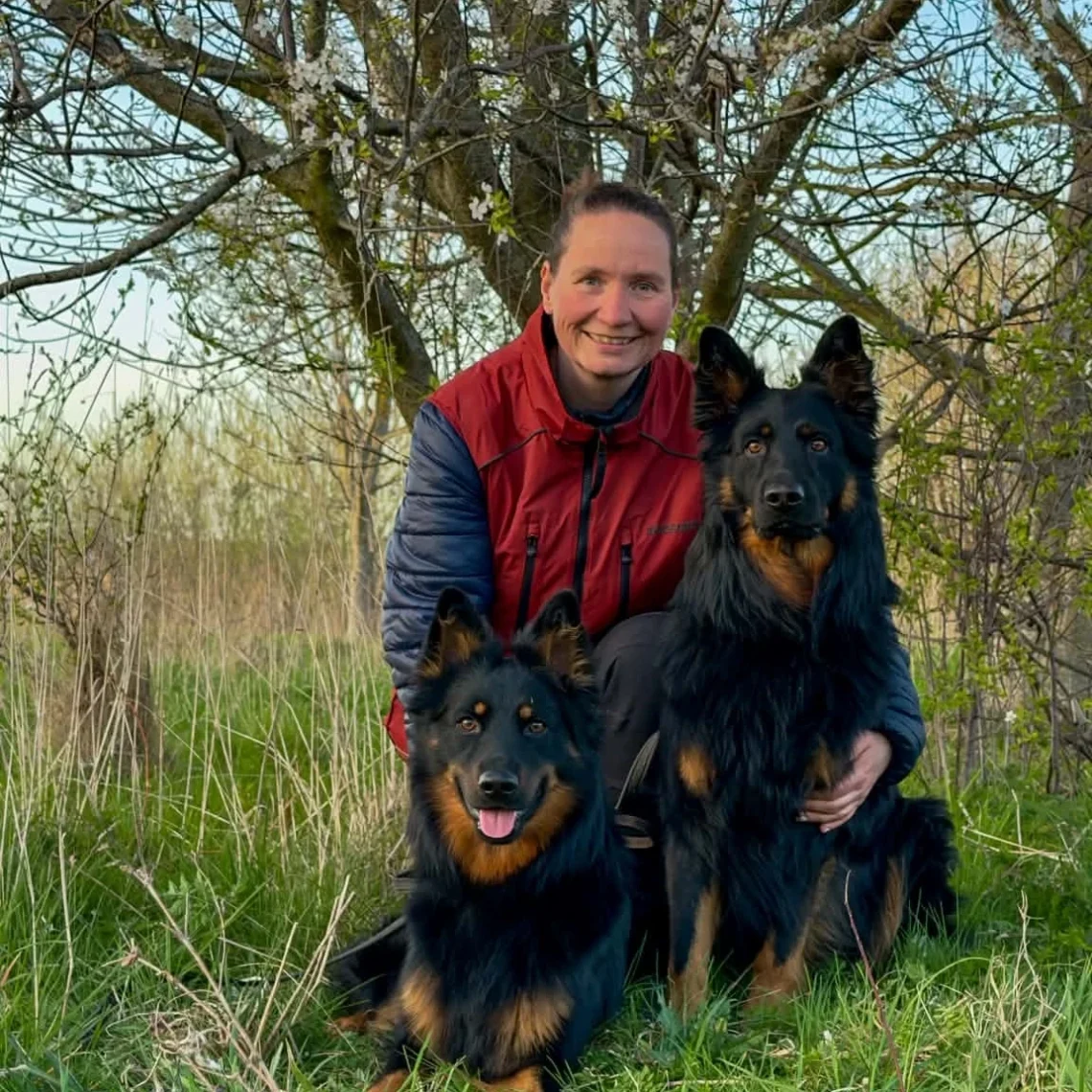
“DCH for everyone
DCH’s motto is “DCH for everyone,” and that really sums up what DCH means to me. It’s not about whether you have a purebred or a mixed breed, whether you aspire to competitions and national championships, or if you simply want a pleasant weekly activity with your dog. There’s room for everyone – both dogs and people.
There’s room for everyone – both dogs and people.
Of course, I can best speak about how we do things at DCH Risskov, where I train and instruct. We offer many opportunities to train with your dog, and you definitely don’t need to have started with a puppy class to join. You can bring a dog of any age and skill level and find a class that suits you. DCH is much more than obedience – there are many activities and disciplines, depending on what you and your dog enjoy.
The DCH programme – from C to Elite
If you want to try competitions, the DCH programme consists of four classes: C, B, A, and Elite, with increasing difficulty and requirements as you progress through the programme.
| C | B | A | ELITE |
The C class is the entry point to the competition world for new handlers. The programme includes heeling on lead, stand, sit, down, jumping, tracking, field, and retrieving. To advance to the B class, you must achieve at least 110 out of 150 points twice.
Once you have qualified from C to B, your future dogs will start directly in the B class. Here, you find many of the same exercises, but with increased difficulty. The lead is removed in heeling, stand and sit are performed while walking, the handler hides during down, and jumping, tracking, and field exercises become more demanding. Additionally, tracking and sending out are introduced as new exercises. Two results of at least 160 out of 200 points grant access to the A class.
In the A class the demands increase again. The obedience exercises become more advanced, the jump gets tougher, tracking and sending ahead cover longer distances, and the patrol exercise is replaced by a larger search task where dog and handler must together comb a forest area for two decoys. A new exercise is also introduced: barking at a dead object, where the dog must find and bark at a so-called “dead” item – for example, a suitcase or a vacuum cleaner. To qualify for the Elite class, two scores of at least 260 out of 300 points are required.
The Elite class is, as the name suggests, the highest level in the DCH programme. Here you’ll find truly skilled and often very experienced handlers – and in short, nearly everything becomes bigger, longer, and more challenging. For example, the “dead” object becomes part of the search exercise, and in the jump exercise the judge decides whether the dog should stand or sit with the retrieve on the far side of the jump.
The programme is designed so that dog and handler are continually challenged more as they develop together.
“The programme is structured so that dog and handler are constantly pushed further as they progress together.
From agility with Goofy to competitive dog
My own story with DCH actually began way back in the late ’90s, when as a teenager I started agility with my first Toller, Goofy. We had a great time, but since I didn’t have a driving licence yet, I was reliant on others to get to training. When those I travelled with stopped, my first DCH adventure came to an end as well.
In 2008, I got my next Toller, Mickey, and in 2009 we began puppy classes at DCH Risskov. The plan was really just a bit of casual dog training. Then I met the club chairman, Ole.
He persuaded me to become an instructor – and that sealed my fate, I suppose.
When Baloo, my third Toller, arrived in 2011, he became my first real competition dog, and suddenly the DCH programme started to mean a lot more.
You learn along the way
With Baloo, I knew pretty much nothing about the DCH programme, so I was constantly a bit behind. Only when we completed the C class did it occur to me that it might be a good idea to start training tracking, which awaited in the B class.
Then, in 2016, as we were preparing for the national championship in the B class, I thought: Hey, maybe I should start training search too, since it’s a big part of the A class.
Safe to say, I learned the programme on the go!
When I got my first Chodsky Pes, Sully, in 2020, I had learned my lesson. We started early work on both tracking and searching, so this time I could be a bit ahead. I continue the same approach today with my young Chodsky Pes, Woody, from 2024.
For me, it’s all about continually developing the training and really delving into each exercise. At the same time, it’s important to stay updated with the programme and any changes. We’re fortunate at DCH Risskov to have a chairman who is excellent at keeping us competitors informed.
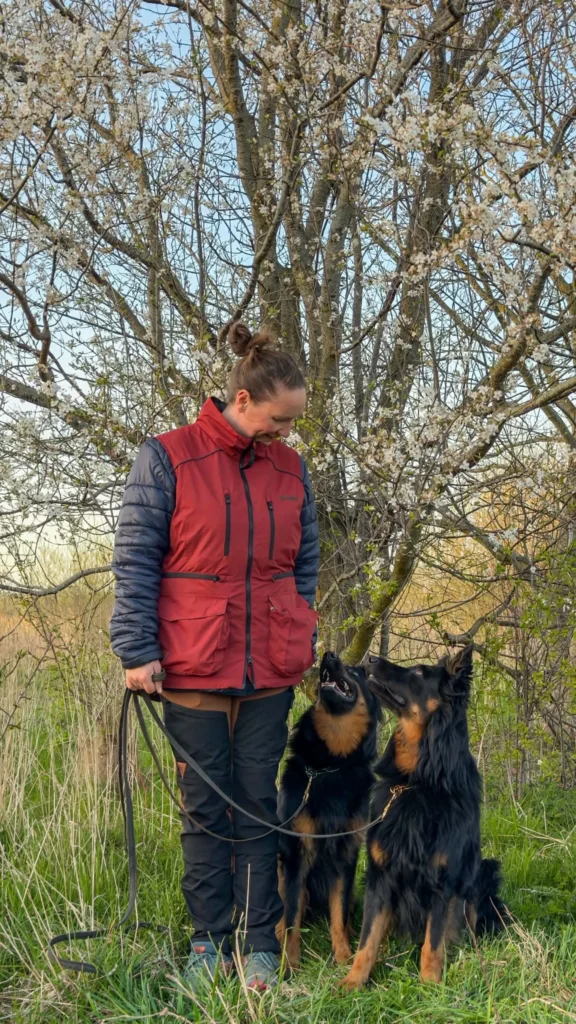
The teamwork and joy of training are a big part of what motivates me in dog sports.
The Best of DCH
One of the things I love most about DCH is the camaraderie and sense of community. In our club, that’s a huge part of what makes training so enjoyable.
But of course, I also love the actual dog training itself. The collaboration with my dogs, the development, and the chance to really focus on one exercise and figure out what works best for that particular dog. No two dogs are the same, and that’s a big part of the fascination for me.
My greatest experiences with DCH have been the times when training and working with my dogs have taken us all the way to the Danish Championships. In 2016, I took part in the DCH programme at the Danish Championships with Baloo, and in 2025, I competed at the Danish Championships in IFH3 tracking with Sully. Those are experiences I’ll never forget.
So why do I keep going?
Over the years, DCH has become much more than just a place where I go to train my dogs.
Of course, it’s the joy and passion for dog training that still drives me. I love the process, the partnership with the dogs, and the feeling when something you’ve worked on for a long time suddenly clicks.
But DCH has also become a big part of my social life. Nowadays, most of my friendships are through DCH.
So perhaps the motto “DCH for everyone” fits my story pretty well. I started as a teenager with a Toller and an agility class, without any big plan. Since then, it has grown to several dogs, instructor work, countless hours of training, competitions, Danish Championship appearances, and lifelong friendships.
And I’m still not done immersing myself in dog training.
DCH – dog training, community, and room for everyone